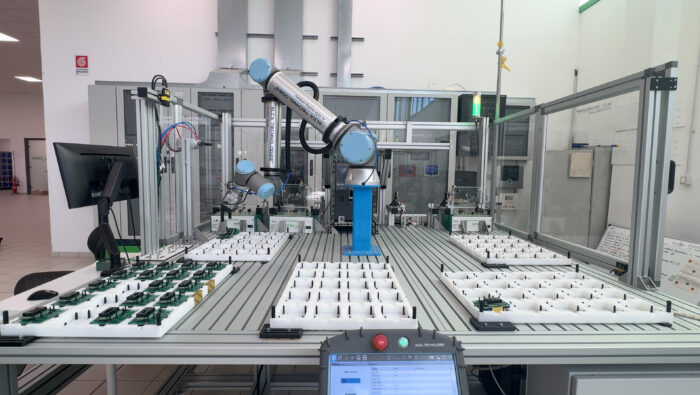
The new test bench, based on UR Robot technology, automatically handles the movement of circuit boards to the test stations, checks the results, and separates conforming from non-conforming parts. This makes the testing process more continuous and reliable, reduces operational variability, and improves overall control of the verification phase.
The project is also part of the evolution toward the Industry 5.0 model, introducing advanced tools for monitoring energy consumption in real time. The continuous collection and analysis of process energy data make it possible to improve performance, identify potential inefficiencies, and optimize resource use. It is therefore not just a matter of technological innovation, but of a new, more conscious way of working—one that is efficiency-oriented and mindful of consumption.
This 5.0 project also includes a Team System MES, designed for real-time monitoring of manufacturing activities and to improve the company’s operational management. The system collects data directly from the production process, monitors activity progress, enhances the traceability of operations, and provides immediate information to support decision-making. The integration of the MES represents an important step toward an increasingly connected factory, where digitalization becomes a practical tool for increasing control, visibility, and operational effectiveness.
To date, the VCO, VMF, FCO, and VCL boards have already been programmed and tested, marking a major milestone in the project’s development. This result confirms the validity of the technical approach adopted and concretely demonstrates the effectiveness of the new automated testing system. Introducing collaborative technologies into a delicate process such as testing presents a significant challenge. It is not simply a matter of automating a manual task, but of rethinking the process from a digital perspective, integrating automation, data collection, and continuous performance monitoring. This approach improves process quality and makes operations more controlled, standardized, and reliable.
The project stems from a desire to improve the overall quality of the production process. Automating the testing of circuit boards reduces the likelihood of errors, standardizes operations, and ensures more reliable results. In a manufacturing environment increasingly focused on precision, control, and sustainability, these aspects are fundamental to sustaining the company’s competitiveness. This investment therefore represents not only a technical advancement but also a significant step toward more modern, integrated, sustainable, and quality-oriented processes, transforming technological innovation into a tangible advantage for continuous improvement.
Davide Verna
Project Manager