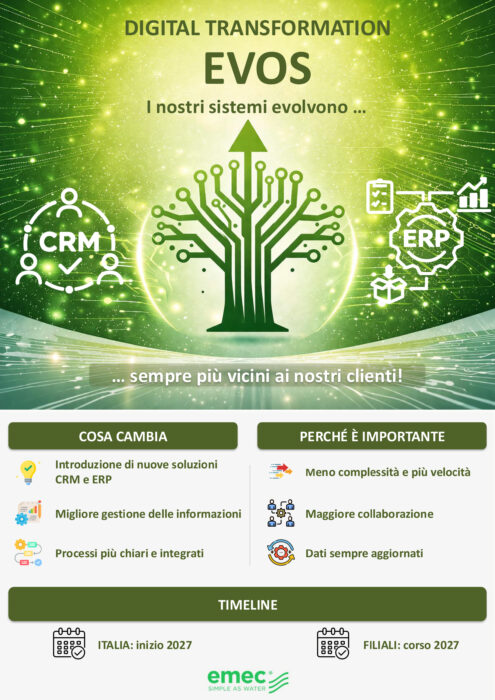
This initiative is called EVOS (EVOlution of Systems), a structured program that encapsulates the company’s ambition to bring about a profound and sustainable evolution of its systems and processes. To support this transformation, EMEC is collaborating with one of the leading international consulting firms in the field of system integration, ensuring a robust methodological approach aligned with industry best practices.
The project began with an in-depth assessment conducted in late 2025, which involved all company departments across the board. This work made it possible to identify the main gaps compared to industry best practices, providing an objective foundation on which to build the path forward. Following this analysis, EMEC decided to concentrate its efforts on core processes (Sales, Operations, and R&D), with a specific focus on CRM and ERP, recognized as key drivers for improving efficiency, control, and decision-making capabilities.
From a technological standpoint, the direction is clear: to strengthen and expand the use of Salesforce for managing business processes and to implement SAP as the new ERP system, replacing the current Microsoft Dynamics NAV platform. In this context, the adoption of Artificial Intelligence-based solutions will also play an increasingly central role, enabling business processes to evolve further toward predictive models, improving the quality of decisions, and automating low-value-added activities. This choice is not random but is part of a global trend: today, over 75% of enterprises use advanced ERP systems, while in the CRM market, Salesforce holds a global market share of over 20%, confirming its position as the industry leader.
The expected benefits of this transformation are supported by concrete data. Market studies indicate that adopting next-generation ERP systems can lead to an increase in operational efficiency of between 15% and 25%, thanks to better process integration and a reduction in manual tasks. On the CRM front, companies using advanced platforms report, on average, a 20–30% increase in sales team productivity and an improvement of up to 35% in customer satisfaction, thanks to more effective relationship and data management.
Another key factor is internal adoption. Modern platforms such as Salesforce and SAP boast adoption rates of over 80% when accompanied by structured change management and training programs. This aspect is particularly relevant for EMEC, where Salesforce is already in place but only partially utilized: the project therefore represents an opportunity not only for implementation but also for fully leveraging existing tools.
Having entered the phase of in-depth analysis and process review in 2026, EMEC is working to set the standard for industry best practices while ensuring an effective and sustainable transition. The go-live scheduled for the Corporate division by the end of the year will mark a crucial milestone, followed in 2027 by the rollout to branches, with a view toward standardization and scalability.
In short, the EVOS project is not just a technological upgrade, but a cultural and organizational transformation. It marks the shift from fragmented systems to an integrated platform, from reactive processes to predictive models—thanks in part to artificial intelligence—and from good performance to excellent performance. And it is precisely through this evolution that EMEC is laying the groundwork to compete at the highest levels of its industry.
For those who are part of the company every day, it means playing a direct role in building a more effective, modern, and future-oriented way of working. For customers and partners, it represents a concrete promise of a service that is even more reliable, faster, and better tailored to their needs. The transformation is already underway: following it closely will be the best way to discover its full potential.
Francesco Pietrolucci
Director of Customer & Marketing Excellence